
One of the fundamental challenges facing postmodernism in America is that the deconstruction of hierarchy and archetypes has made for bad art. At first, it was new edgy. Take everything from visual art to cinema and you see an early enthusiasm for the newness of deconstruction within Western Civilization. Likewise, various forms of modernism seemed to promise the possibility of a better world, a world freed from the tyranny of gender roles, class distinction, and power inequalities. The implicit cry of modernism and postmodernism was the radical possibility of freedom now that God and traditional thinking was dead.
As I have lived longer, these ideas have grown cold and have degraded into decadence. Freedom was not achieved, inequalities exist now as they did then, and for the most part society still seems to function off of some hidden law enforced by nothing but the very fabric of reality. The idea of a natural law is no longer universally accepted, and yet every time society attempts to work against its, dare I say, karma, the same result ensues. For every action, there always seems to be an equal and opposite reaction. The laws of nature are more than simply those that govern physical reality and the empirical science, but are the primary code of reality.
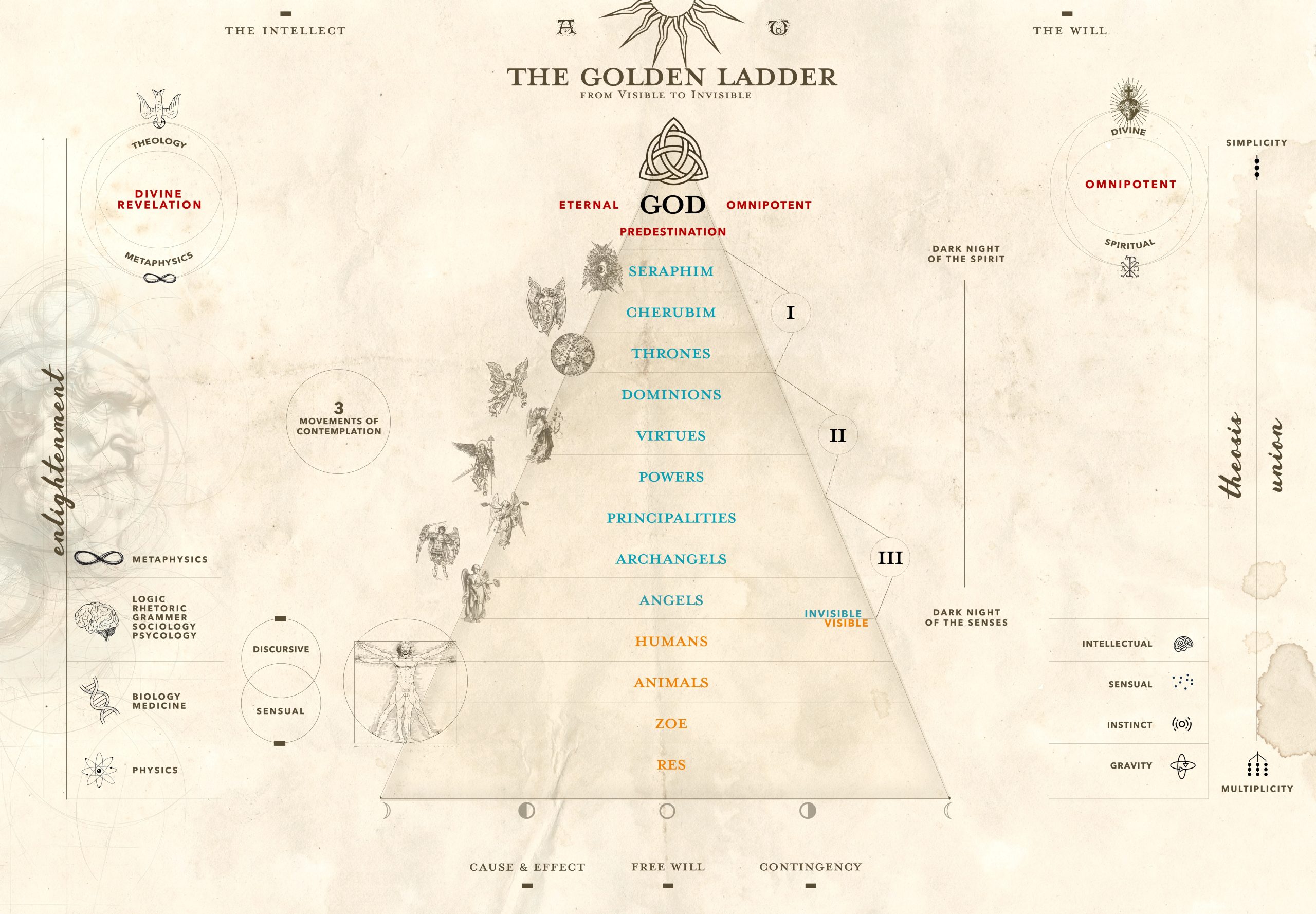
Aquinas summarizes that the third degree of contemplation is “to judge of sensible objects according to intelligible things.” Modernists and postmodernists would have us believe that the imposition of a “system” is arbitrary and not tied to ability to claim an objective truth. If you want to accept that as your faith, by all means, but I sense if you have made it this far, you believe otherwise. Ideas, concepts, laws, and metaphysical structures not tied to immediate, concrete realities are not simply artificial constructs we impose on reality.
The discovery of truth allows us to interact with the sensible world in an orderly and virtuous way. We don’t simply impose a system on reality, but rather we discover the system underlying reality and are able to interact with it in a fruitful manner. This is the domain of wisdom. Reality is intelligible and has consistent patterns that aid us in interacting with it to cultivate the good life. Wisdom goes beyond technical mastery of specific skills but allows us to learn from repeated experience.
In this context, religion and philosophy is not simply concerned with subjective states but is the fundamental coordination of reality. Each religion and philosophy can be arranged in order by its correspondence with reality and its relationship with objective truth. The fundamental view of Catholicism is that it is the religious system most perfectly aligned with reality because it was revealed by God for the good of man. We’ll come back to that point later, but at the least we see that to see all things through the eyes of faith is the key to objectively understanding and judging the world we live in.
In our time, there is a rediscovery of mythology and an interest in archetypes through the work of Jordan Peterson. He has appropriated the psychology of Jung and integrated it within his work on what is called the “Big Five” theory of human temperament. While his ideas are unique in their application, the notion of personal temperament and archetypical wisdom is not new to Western Civilization. It seems as though St. Paul has this kind of thinking in mind when he critiques what he calls “cleverly concocted myths.’ Furthermore, the 4 temperaments have been a staple of Western Civilization for over 2k years.
That being said, what was true then and is true now is that we interact with the world through the play of patterns which systematize themselves in stories and characters. The fundamental difference between scripture and mythology is that the claim of revelation is that the patterns found in scripture are not man made but revealed by God through the unfolding of salvation history. God reveals the patterns of human behavior through the historical account of his people, Israel, and their fulfillment in his new covenant through the Church, the Body of Christ.
Though the Bible never explicitly makes the claim that all the patterns of human existence are contained within, I think it is appropriate here to make such a claim. The Bible tells a narrative of human history which we can appropriate and use to understand all things. This is the essence of what is traditionally called the allegorical interpretation of scripture. Thus the allegorical interpretation of scripture is nothing short of the discovery of the primordial archetypes existing in the mind of God but shown forth through the Word of God.
So we can say that the eternal law is made through the natural law and the natural law is appropriated through the historical account of the scriptures. The Mosaic law takes flesh in the lived history of Israel and is fulfilled when the eternal logos takes flesh in the person of Jesus Christ. Jesus Christ is at the top of the hierarchy of archetypical wisdom and he is the hermeneutic key wherein lies the mystery of all allegorical interpretations of scripture. To meditate on the life of Christ is to appropriate wisdom in its purest form. This is why the meditation on the rosary can train even the simplest of minds in the divine art and be a path towards the sublime contemplation of the divine essence.